Total Pageviews

Saturday, May 8, 2021

Things Fall Apart

# Thinking Activity

Hello readers! 

        Here, I would like to present my views on the novel "Things Fall Apart" By Chinua 
Achebe, here are some question, which is given by our ma'am, so here I would like to gave my views on these questions. 


Things Fall Apart is the debut novel by Nigerian author Chinua Achebe, first published in 1958. It depicts pre-colonial life in the southeastern part of Nigeria and the arrival of Europeans during the late 19th century.

#  About author


        Chinua Achebe was a Nigerian novelist, poet, and critic who is regarded as the dominant figure in modern African literature. His first novel and magnum opus Things Fall Apart, occupies a pivotal place in African literature, and remains the most widely studied, taught and read African novel.


1. What is historical context of Things Fall Apart?

Things Fall Apart is set in the 1890s and portrays the clash between Nigeria’s white colonial government and the traditional culture of the indigenous Igbo people. Achebe’s novel shatters the stereotypical European portraits of native Africans. He is careful to portray the complex, advanced social institutions and artistic traditions of Igbo culture prior to its contact with Europeans. Yet he is just as careful not to stereotype the Europeans; he offers varying depictions of the white man, such as the mostly benevolent Mr. Brown, the zealous Reverend Smith, and the ruthlessly calculating District Commissioner.

2. What is the significant of the title?

Things Fall Apart by Chinua Achebe is a novel whose title bears the central massage of the work. The very title ‘Things Fall Apart’ foreshadows the tragedy which takes place at the end of the novel. The novel depicts the tragedy of an individual as well as the tragedy of a society. The protagonist of the novel Okonkwo who was rich and respectable at the beginning of the novel meets a tragic fate at the end of the novel. Achebe portrays how an ambitious, well known, and respected African Okonkwo’s life falls apart. But when he suffers, his whole tribe also suffers. At the beginning of the novel, the Ibo society was a peaceful, organic society, but at the end of the novel it falls into pieces. Thus, the novel records not only falling apart of Okonkwo’s life but also his whole society.

4. What do you think about the incident of Ikemefuna? How does it help to understand the Ibo culture in more specific ways?

Ikemefuna comes to Umuofia early in the book, as settlement for a dispute with a nearby village. Not knowing what else to do with him, Okonkwo lets Ikemefuna live with his first wife. Ikemefuna quickly becomes a well-loved member of the family. He serves as a role model for Okonkwo’s eldest son, Nawoye, and over time he also earns Okonkwo’s respect. But more important than the role he plays in Okonkwo’s family is the effect his death has on the unfolding events of the novel.

When the village elders decide the time has come to kill Ikemefuna and finally settle the dispute with the neighboring village, Okonkwo insists on taking part in the execution, despite the fact that the boy calls him “father.” Okonkwo ends up killing Ikemefuna himself out of fear that his failure to take responsibility would make him look weak. Ikefuma’s death irreversibly harms the relationship between Okonkwo and Nwoye. His death is also a bad omen that has a symbolic connection to Okonkwo’s later exile from Umuofia. In this sense, the death of Ikemefuna signals the start of things falling apart.


Sunday, May 2, 2021

Fame and Friendship

 #Fame and Friendship by


The Old Woman

 #The Old Woman by Joseph Campbell

As a white candle
In a holy place, 
So is the beauty
Of an aged face.

As the spent radience
Of the winter sun, 
So is a woman
With her travail done.

Her brood gone from her,
And her thoughts as still 

As the watersUnder a ruined mill. 


                The poem 'The Old Woman' is written by Joseph Campbell. The poem is divided into 3 stanza. The meaning of the  poem is deeper than any romantic poem. The poem is very simple, realistic poem. The poet has given  the description  of old lady by different comparisons . It s very natural to see beauty in young women , but t is very understanding to describe the beauty of old woman.  It requires great imaginative power to see beauty in old age.

                In  the first stanza , the poet compares the old lady with the white candle. As the white candle in the holy place gives light and guided  the person who comes there. It is the symbol  of holy figure. Likewise the old lady's face  compared with the white candle. The old lady guides others by the using experience. She enlightens  the life of others. Moreover, white candle is a symbol of beauty. The poet finds beauty in her face.

                In the second  stanza, the poet compares the old lady with the spent radiance of the winter's sun. It means passing of time, and as the sun travels more and more in the sky it spends its radiance more and more. Through the time passes , she has gathered a wide experience of life. Moreover , at the  sunshine the sunset looks beautiful due to radiance. Here, the same thing for the old lady. Here wide range of experience is an extra ornaments in the life of old lady.  It adds charms in her beauty.

                In the final stanza, the poet compares the old woman with the ruined water of the mill. They neither vanished nor runs away. So here the same position for the old lady. Her broods have gone away from her in old age and , her thoughts are still as ruined waters of the mills. It means it suggests steadiness and maturity in the life of old lady

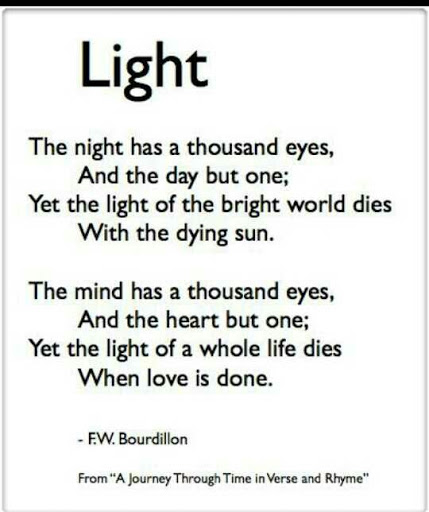
Light

#Poem Light by D. H. Thoreau


This poem sings songs of heart and love. The message of the poem is that without love the world is no longer place to live.

The poet uses day and night as metaphors. He says that night has thousands eyes means in night there are thousands of stars but it does not give light. But day has only one eye but it gives light. When sun sets the world of light ends.

Same way mind has thousand eyes while heart has one where love lives. Like sun if love is gone then the whole life dies.

So it is very short and simple poem.

Dr. Jekyll and Mr. Hyde

 # Dr. Jekyll and Mr. Hyde by Robert Louis Stevenson

Hello Readers! 

     This novella "Dr. Jekyll and Mr. Hyde" Is the first novel, which I have studied in by graduation years, here I would like to write briefly about it. 


    Strange Case of Dr Jekyll and Mr Hyde is a Gothic novella by Scottish author Robert Louis Stevenson, first published in 1886. The work is also known as The Strange Case of Jekyll Hyde, Dr Jekyll and Mr Hyde, or simply Jekyll and Hyde.

Good versus Evil

Dr. Jekyll and Mr. Hyde is as an allegory about the good and evil that exist in all men, and about our struggle with these two sides of our personality. In the novella the battle between good and evil rages within the individual. Since Hyde seems to be taking over, one could argue that evil is stronger than good. However, Hyde does end up dead, perhaps suggesting a weakness or failure of evil. The big question, of course, is whether or not good can be separated from evil, or whether the two are forever intertwined.

Repression

Repression is indisputably a cause of troubles in Dr. Jekyll and Mr. Hyde. The repression here is that of Victorian Britain: no sexual appetites, no violence, and no great expressions of emotion, at least in the public sphere. Everything is sober and dignified. The more Jekyll’s forbidden appetites are repressed, the more he desires the life of Hyde, and the stronger Hyde grows. We see this after Dr. Jekyll’s two-month hiatus from being Hyde; Dr. Jekyll finds that the pull to evil has been magnified after months of repression.

The Bluest Eye

 # The Bluest Eye by Tony Morrison

   Hello Readers! 

    In this micro blog I would like to write about the novel "The Bluest Eye" by Tonny Morrison. 


   The Bluest Eye, published in 1970, is the first novel written by Toni Morrison. The novel takes place in Lorain, Ohio, and tells the story of a young African-American girl named Pecola who grew up following the Great Depression. 

The power of stories

The Bluest Eye is not one story, but multiple, sometimes contradictory, interlocking stories. Characters tell stories to make sense of their lives, and these stories have tremendous power for both good and evil. Claudia’s stories, in particular, stand out for their affirmative power. First and foremost, she tells Pecola’s story, and though she questions the accuracy and meaning of her version, to some degree her attention and care redeem the ugliness of Pecola’s life. Furthermore, when the adults describe Pecola’s pregnancy and hope that the baby dies, Claudia and Frieda attempt to rewrite this story as a hopeful one, casting themselves as saviors. Finally, Claudia resists the premise of white superiority, writing her own story about the beauty of blackness. Stories by other characters are often destructive to themselves and others. The story Pauline Breedlove tells herself about her own ugliness reinforces her self-hatred, and the story she tells herself about her own martyrdom reinforces her cruelty toward her family. Soaphead Church’s personal narratives about his good intentions and his special relationship with God are pure hypocrisy. Stories are as likely to distort the truth as they are to reveal it. While Morrison apparently believes that stories can be redeeming, she is no blind optimist and refuses to let us rest comfortably in any one version of what happens.


Animal Farm

#Animal Farm

    - By George Orwell

Hello readers! 

  Here, in this blog I would like write one of novella, which is also part of my B. A. Syllabus, "Animal Farm" Written by George Orwell. 

  Animal Farm is an allegorical novella by George Orwell, first published in England on 17 August 1945. The book tells the story of a group of farm animals who rebel against their human farmer, hoping to create a society where the animals can be equal, free, and happy. 


Why Animal Farm is an allegory? 

Old Major, a prize-winning boar, gathers the animals of the Manor Farm for a meeting in the big barn. He tells them of a dream he has had in which all animals live together with no human beings to oppress or control them. He tells the animals that they must work toward such a paradise and teaches them a song called "Beasts of England" in which his dream vision is lyrically described. The animals greet Major’s vision with great enthusiasm. When he dies only three nights after the meeting, three younger pigs—Snowfall, Napoleon and formulate his main principles into a philosophy called Animalism. Late one night, the animals manage to defeat the farmer Mr. Jones in a battle, running him off the land. They rename the property Animal Farm and dedicate themselves to achieving Major’s dream. The cart-horse Boxer devotes himself to the cause with particular zeal, committing his great strength to the prosperity of the farm and adopting as a personal maxim the affirmation “I will work harder.”

At first, Animal Farm prospers. Snowball works at teaching the animals to read, and Napoleon takes a group of young puppies to educate them in the principles of Animalism. When Mr. Jones reappears to take back his farm, the animals defeat him again, in what comes to be known as the Battle of the Cowshed, and take the farmer’s abandoned gun as a token of their victory. As time passes, however, Napoleon and Snowball increasingly quibble over the future of the farm, and they begin to struggle with each other for power and influence among the other animals. Snowball concocts a scheme to build an electricity-generating windmill, but Napoleon solidly opposes the plan. At the meeting to vote on whether to take up the project, Snowball gives a passionate speech. Although Napoleon gives only a brief retort, he then makes a strange noise, and nine attack dogs—the puppies that Napoleon had confiscated in order to “educate”—burst into the barn and chase Snowball from the farm. Napoleon assumes leadership of Animal Farm and declares that there will be no more meetings. From that point on, he asserts, the pigs alone will make all of the decisions—for the good of every animal.

Napoleon now quickly changes his mind about the windmill, and the animals, especially Boxer, devote their efforts to completing it. One day, after a storm, the animals find the windmill toppled. The human farmers in the area declare smugly that the animals made the walls too thin, but Napoleon claims that Snowball returned to the farm to sabotage the windmill. He stages a great purge, during which various animals who have allegedly participated in Snowball’s great conspiracy—meaning any animal who opposes Napoleon’s uncontested leadership—meet instant death at the teeth of the attack dogs. With his leadership unquestioned (Boxer has taken up a second maxim, “Napoleon is always right”), Napoleon begins expanding his powers, rewriting history to make Snowball a villain. Napoleon also begins to act more and more like a human being—sleeping in a bed, drinking whisky, and engaging in trade with neighboring farmers. The original Animalist principles strictly forbade such activities, but Squealer, Napoleon’s propagandist, justifies every action to the other animals, convincing them that Napoleon is a great leader and is making things better for everyone—despite the fact that the common animals are cold, hungry, and overworked.

Mr. Frederick, a neighboring farmer, cheats Napoleon in the purchase of some timber and then attacks the farm and dynamites the windmill, which had been rebuilt at great expense. After the demolition of the windmill, a pitched battle ensues, during which Boxer receives major wounds. The animals rout the farmers, but Boxer’s injuries weaken him. When he later falls while working on the windmill, he senses that his time has nearly come. One day, Boxer is nowhere to be found. According to Squealer, Boxer has died in peace after having been taken to the hospital, praising the Rebellion with his last breath. In actuality, Napoleon has sold his most loyal and long-suffering worker to a glue maker in order to get money for whisky.

Years pass on Animal Farm, and the pigs become more and more like human beings—walking upright, carrying whips, and wearing clothes. Eventually, the seven principles of Animalism, known as the Seven Commandments and inscribed on the side of the barn, become reduced to a single principle reading “all animals are equal, but some animals are more equal than others.” Napoleon entertains a human farmer named Mr. Pilkington at a dinner and declares his intent to ally himself with the human farmers against the laboring classes of both the human and animal communities. He also changes the name of Animal Farm back to the Manor Farm, claiming that this title is the “correct” one. Looking in at the party of elites through the farmhouse window, the common animals can no longer tell which are the pigs and which are the human beings.